Best Family Prank Games: Fun Ways to Bring Laughter Home
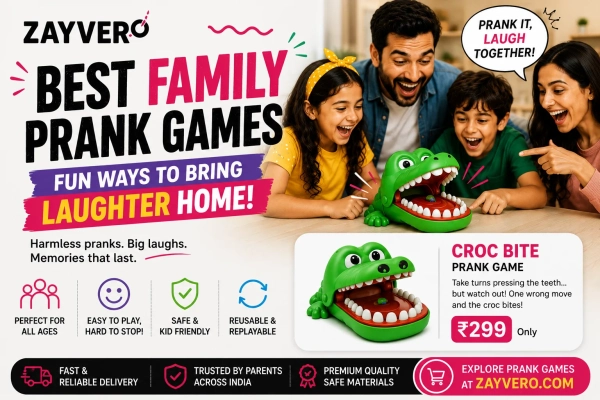
Not every family game night needs a board, a timer, or a strict set of rules to be memorable — sometimes the best moments come from a well-timed, harmless prank that has everyone, including the person on the receiving end, laughing until they can't breathe. That's exactly what a good family prank game delivers.
This guide covers what makes a prank game genuinely fun rather than frustrating, what to look for before you buy, and how to choose the right one for your child's age and your family's sense of humour.
What Is a Family Prank Game, Exactly?
A family prank game is any toy or game built around a harmless surprise — a startling sound, a silly mess, a trick outcome, or a "gotcha" moment — designed to make everyone laugh rather than to embarrass or upset anyone. Unlike a one-off prank you might play on April Fools' Day, these are reusable games meant to be played again and again, often with rotating "victims" so nobody's left out of the fun.
The best ones are built around a simple, repeatable mechanic: a spring-loaded surprise, a random "who gets it" element, or a countdown that keeps everyone guessing. No batteries or setup complexity required — just a group of people willing to laugh at themselves.
Why Family Prank Games Are Worth Adding to Game Night
They level the playing field. Unlike trivia or strategy games where the same person often wins every time, most prank games run on luck and timing — a 6-year-old has just as good a shot at "getting" a parent as an older sibling does.
They break the ice fast. Prank games are especially good for mixed-age gatherings, family get-togethers, or when cousins who don't see each other often need something to bond over immediately, without needing to learn complicated rules first.
They're short and repeatable. Most rounds last a few minutes, which makes them easy to slot in before dinner, during a car trip stop, or as a five-minute break between longer board games.
They teach good-natured resilience. Being on the receiving end of a harmless, funny prank — and laughing about it — is a small but genuine lesson in not taking yourself too seriously.
What to Look For When Buying
1. Genuinely Harmless Surprise Mechanics
The single most important factor. A good prank game startles or surprises without ever hurting, pinching, or genuinely frightening a child. Steer clear of anything with sudden sharp movement, loud unexpected bangs beyond a mild pop or squirt, or any mechanism that could catch small fingers.
2. Reusability
Some prank games are one-time novelties — fun once, forgettable after. The better ones (spring-loaded surprise boxes, "whose turn will it be" style games) can be reset and replayed dozens of times without losing their impact, since the surprise element resets with the game itself.
3. Mess Factor
A handful of prank games involve foam, water, or powder for extra comic effect. These can be great fun outdoors or in a space that's easy to clean, but check the mess level against where you'll actually be playing before buying — a prank that's hilarious in the garden can be a headache on the living room carpet.
4. Group Size and Player Count
Some prank games are built for two players taking turns; others are designed for a full table of 4–8 people passing a device around. Match this to how your family actually gathers — a two-player prank toy will get boring fast at a big family reunion.
5. Humour That Matches Your Family
Prank games range from very mild and toddler-friendly (a silly noise, a pop-up surprise) to cheekier options aimed at older kids and teens (mild "gotcha" dares, embarrassing mini-challenges). Pick one that matches what will actually land as funny — not awkward — for your specific group.
Choosing Prank Games by Age
4–6 years: Look for simple cause-and-effect surprises — a pop-up character, a gentle noise, or a "squeeze and see what happens" mechanic. At this age, the surprise itself is the whole joke; nothing needs to be clever or layered.
7–9 years: Kids this age start enjoying the anticipation as much as the surprise — games with a countdown, a spinning "whose turn" element, or a light dare component tend to be a strong fit.
10+ years and family mixed groups: Older kids and adults tend to enjoy prank games with more unpredictability — random outcome mechanics, mild embarrassing mini-challenges, or games that let the "prankster" role rotate so everyone gets a turn dishing it out and taking it.
Prank Games vs. Classic Board Games: What's the Real Difference?
It's a fair question, since both live in the same "family game night" space. The core difference comes down to pacing and skill.
Classic board games usually reward strategy, memory, or vocabulary, and a single game can run 30–60 minutes. Prank games, by contrast, are built for quick, high-energy bursts — most rounds are over in under a minute, luck matters more than skill, and the fun comes from reaction and surprise rather than sustained strategic thinking.
Many families find prank games work best as a warm-up or a palate-cleanser between longer, more strategic games, rather than as the main event of the evening — they keep energy high without demanding the same sustained attention.
Prank Games and Family Gatherings: A Natural Pairing
Because most prank games need no setup beyond opening the box, they're a strong fit for gatherings where you can't rely on a table and an hour of uninterrupted time — a birthday party, a festival get-together, or cousins visiting for the weekend. The randomness also means new players can jump in mid-session without needing to catch up on rules, which isn't true of most strategy-based board games.
Common Mistakes When Buying Prank Games
Choosing something too intense for the youngest player in the room. A prank that's hilarious for a 10-year-old can genuinely scare a 4-year-old. If your gatherings span a wide age range, look for games explicitly labelled as gentle or toddler-friendly, or plan to sit those rounds out with younger kids.
Ignoring the mess factor until it's too late. Read the packaging carefully for anything involving foam, water, or powder, and decide in advance whether that's a "backyard only" game or genuinely fine indoors.
Assuming every child wants to be pranked in front of others. Some kids love being the centre of attention when "caught out"; others find it embarrassing. Read the room, and don't force a reluctant child to take their turn as the target.
Buying single-use novelty items instead of reusable games. A few prank products are genuinely one-and-done. Check for "resettable" or "replayable" language before buying if you want something that earns its shelf space beyond a single evening.
Tips for a Great Prank Game Session
Set a light-hearted tone before you start. A quick "we're all going to get pranked tonight, and that's the fun of it" reminder helps everyone go in with the right expectations.
Rotate who goes first. Letting the youngest player start (or "spin" first) tends to build excitement rather than nerves, since it removes any sense that adults are always in on it together against the kids.
Keep a mild game in your back pocket for younger siblings. If your main game skews a little older, having one gentler option ready means nobody has to sit out entirely.
Know when to stop. Prank games are at their best in short bursts — three or four rounds is often the sweet spot before the novelty starts to fade for the evening.
Frequently Asked Questions
Are prank games safe for young children? Yes, provided you choose age-appropriate options — gentle pop-up or sound-based surprises for younger kids, and save more elaborate "gotcha" mechanics for older children and mixed adult-child groups.
Do prank games need batteries? Some do (for sound or light effects), while many rely purely on spring-loaded or mechanical surprises. Check the product description if you'd prefer a battery-free option.
Can prank games be played with just two people? Some are designed specifically for two players, though most family prank games are built for group play of 3 or more, since the rotating "who's next" element is a big part of the fun.
Are prank games reusable, or one-time novelties? This varies by product — look for games described as "resettable" or "replayable" if you want long-term value rather than a single-use surprise.
Final Thoughts
The best family prank games aren't about catching someone out — they're about creating a shared moment everyone ends up laughing about, including whoever got pranked. Choosing one with genuinely harmless mechanics, the right intensity for your youngest player, and a format that resets easily is what turns a novelty purchase into a game your family actually reaches for again and again.
Browse Zayvero's full Games & Novelty Toys collection to find prank and party games suited to your family's next game night. Shop Now →