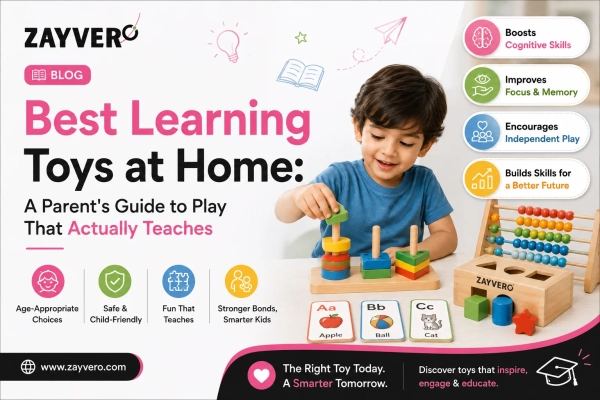
Best Learning Toys at Home: A Parent's Guide to Play That Actually Teaches
Every parent has heard some version of the phrase "children learn through play," but it doesn't always translate into knowing what to actually buy. Walk down any toy aisle and nearly every box claims to be "educational" in some way — which makes the label almost meaningless unless you know what to look for underneath it.
This guide cuts through the marketing and breaks down what genuinely makes a toy educational, which categories deliver the most developmental value at home, and how to build a learning-focused toy rotation without turning your living room into a classroom.
What Actually Makes a Toy "Educational"?
Not every toy labelled educational earns the title. A genuinely educational toy shares a few common traits:
It requires active thinking, not passive watching. A toy that lights up and plays a tune on its own teaches far less than one where the child has to figure out what to do next — stack it, sort it, build it, or solve it.
It scales with the child's ability. The best learning toys aren't mastered in a single sitting. A good set of building blocks, for example, can be used just as meaningfully by a 2-year-old stacking randomly as by a 6-year-old building a specific structure from a plan.
It encourages repeated, self-directed play. If a child returns to the same toy repeatedly, on their own, without being prompted, that's usually a strong signal real learning is happening — because they're testing, adjusting, and mastering something at their own pace.
It connects to a real skill. Fine motor control, early number sense, spatial reasoning, language, or problem-solving — a genuinely educational toy maps to at least one of these, even if the packaging doesn't spell it out directly.
The Core Categories of Learning Toys (And What Each One Teaches)
1. Building and Construction Toys
Blocks, stacking sets, and construction kits are some of the most reliably effective learning toys across almost every age group. They build spatial reasoning, hand-eye coordination, and early problem-solving, and they scale naturally as a child grows — simple stacking for toddlers, more complex structures for older kids. We've covered this in more depth in our guide on the benefits of building blocks, including how to choose age-appropriate sets.
2. Puzzles
Puzzles teach pattern recognition, patience, and problem-solving in a uniquely self-correcting way — a piece either fits or it doesn't, which gives a child immediate, honest feedback without needing a parent to step in and grade the outcome. Chunky wooden puzzles work well for toddlers, while older kids benefit from higher piece-count puzzles that demand more sustained focus.
3. Sorting and Matching Toys
Shape sorters, colour-matching sets, and stacking rings are often dismissed as "baby toys," but they lay the groundwork for categorisation, comparison, and early logic — skills that show up again later in math and reading. For toddlers specifically, this category tends to deliver an outsized amount of learning for a relatively simple toy.
4. Pretend Play Sets
Play kitchens, doctor kits, and role-play sets might not look academic, but they're doing serious developmental work. Pretend play builds language skills, sequencing (first this, then that), social understanding, and emotional regulation, all while a child simply narrates their own imagined scenario out loud.
5. Early STEM Toys
Simple cause-and-effect toys, basic circuit kits, and beginner coding toys introduce logical thinking well before a child is ready for anything resembling formal science or math. These work best when they're hands-on and physical rather than screen-based — a child manipulating actual pieces learns differently, and often more durably, than one tapping a screen.
6. Art and Craft Supplies
Crayons, playdough, and simple craft kits build fine motor control and creative thinking. They're frequently underrated as "learning toys" because they don't look instructional, but the fine motor skills developed through drawing, cutting, and shaping are directly linked to later handwriting ability.
Choosing Learning Toys by Age
0–2 years: Focus on sensory and cause-and-effect toys — things that respond immediately to a simple action, like pressing, shaking, or stacking. At this stage, learning is almost entirely about exploring textures, sounds, and basic object permanence.
2–3 years: Sorting toys, simple puzzles (4–9 pieces), and large building blocks work well. Attention spans are still short, so toys that deliver quick, visible feedback hold interest longer than anything with delayed payoff.
3–4 years: Pretend play sets, more complex puzzles, and early matching games become appropriate. This is also a strong age for introducing simple counting and shape-recognition toys.
4–6 years: Kids at this stage can handle more structured building sets, beginner STEM kits, and puzzles with 20+ pieces. This is often the age where a child's specific interests — animals, vehicles, space, art — start to shape which learning toys hold their attention longest.
For a full breakdown of what's genuinely appropriate at each stage, our Educational Toys collection and Learning Toys page are both organised by age, so you're not left guessing based on box art alone.
Building a Learning Toy Rotation at Home
You don't need dozens of toys to create a genuinely rich learning environment — you need the right mix, rotated intentionally.
Keep the active toy shelf small. Somewhere between 6 and 10 toys visible at once is usually the sweet spot. Too many options at once tends to reduce focus rather than increase engagement, since kids often flit between choices instead of settling into deep play with any single one.
Rotate every 2–3 weeks. Put a portion of the toy collection away in storage and swap it back in later. Toys that have been "gone" for a few weeks often get rediscovered with fresh enthusiasm, essentially resetting their educational value without needing to buy anything new.
Mix categories, not just difficulty levels. A well-rounded rotation includes something for fine motor skills (blocks, puzzles), something for imagination (pretend play), and something for early logic (sorting, matching) — rather than five variations of the same toy type.
Let boredom happen sometimes. A child who occasionally has "nothing to do" often ends up combining toys in unplanned, creative ways — building blocks becoming a pretend kitchen counter, for example. Some of the richest learning moments happen in these self-directed, unscripted stretches.
Signs a Learning Toy Is Actually Working
It's not always obvious in the moment whether a toy is delivering real developmental value. A few practical signs to look for:
- Your child returns to it repeatedly without prompting
- They attempt something slightly harder each time (a bigger tower, a trickier puzzle)
- They narrate or explain what they're doing out loud
- They show visible frustration followed by a breakthrough — a strong indicator of genuine problem-solving, not passive entertainment
- They start combining it with other toys in creative, unplanned ways
If a toy is played with once or twice and then ignored permanently, that's usually a sign it either didn't match the child's current developmental stage or didn't offer enough open-ended flexibility to sustain interest.
Budget-Friendly Learning Toy Picks
Educational value has very little correlation with price. Some of the most developmentally rich toys — building blocks, simple puzzles, sorting sets — sit comfortably in the lower price brackets. If you're building a learning-focused toy box on a budget, it's worth browsing toys under ₹500 before assuming meaningful educational toys require a bigger spend.
Common Mistakes Parents Make When Choosing Learning Toys
Buying based on age labels alone. Age recommendations on packaging are a starting point, not a rule. A child's actual skill level, patience, and interests matter more than the number printed on the box.
Assuming more features mean more learning. A toy with lights, sounds, and pre-recorded phrases often does the "learning" for the child rather than prompting the child to do it themselves. Simpler, quieter toys frequently outperform flashier ones in terms of genuine engagement.
Overloading the toy shelf. As mentioned above, too many toys available at once tends to reduce the depth of play, not increase it. A smaller, well-curated selection almost always outperforms an overflowing toy box.
Ignoring the child's current interest. A puzzle themed around dinosaurs will hold far more attention for a dinosaur-obsessed 4-year-old than a generic, "more educational" alternative. Following genuine interest is one of the most reliable ways to maximise engagement — and therefore learning.
Setting Up a Learning Corner at Home
You don't need a dedicated playroom to create an environment that supports learning through play — a small, consistent corner works just as well.
Keep it low and accessible. Toys stored on low, open shelves (rather than closed bins or high cupboards) let a child choose independently, which builds early decision-making and ownership over their own play. If everything requires asking an adult to reach it, spontaneous, self-directed play becomes far less likely.
Add a flat, dedicated surface. A small table or even a clear section of floor gives building, puzzle, and sorting toys the space they need without constant interruption from foot traffic or shared furniture.
Include a "quiet" option. Alongside more stimulating toys, keep at least one calm, low-stimulation option — a puzzle, a sorting set, or art supplies — for moments when a child needs to wind down rather than ramp up.
Label bins with pictures, not just words. For toddlers and preschoolers who can't read yet, simple picture labels on storage bins let them participate in cleanup and toy selection independently, reinforcing categorisation skills as a side benefit.
Rotate the display, not the storage. Even in a small space, swapping which toys are visible on the shelf every couple of weeks recreates the "fresh toy" effect discussed earlier, without needing extra physical space to store an ever-growing collection.
How Learning Toys Support Skills Beyond Play
The value of a good learning toy often extends well past the moment of play itself, showing up later in contexts that don't look related on the surface.
Early math foundations. Sorting, counting, and pattern-based toys build number sense long before a child encounters formal arithmetic. A toddler stacking rings by size is quietly practising sequencing and comparison — both foundational math skills.
Pre-reading skills. Storytelling through pretend play, along with the vocabulary built during narrated play, directly supports later reading comprehension. Children who engage in rich pretend play tend to have stronger narrative understanding once they start reading independently.
Persistence and frustration tolerance. Puzzles and building toys that don't work on the first attempt teach a child to keep trying — a skill that transfers directly to schoolwork, sports, and eventually workplace problem-solving much later in life.
Fine motor readiness for writing. Toys that require pinching, twisting, stacking, and precise placement build the exact hand muscles and coordination needed for holding a pencil and forming letters, well before formal handwriting instruction begins.
None of this requires expensive, specialised equipment — it's largely a byproduct of consistent, varied, hands-on play with the toy categories covered above.
Frequently Asked Questions
What age should kids start using learning toys? Learning through play starts from birth. Even simple sensory toys and rattles for infants qualify as early learning tools, since they build the earliest foundations of cause-and-effect understanding.
Are screen-based learning toys as effective as physical ones? Physical, hands-on toys generally offer richer developmental benefits for young children, since they engage fine motor skills, tactile feedback, and real-world problem-solving in ways screens can't replicate. Screen-based tools can supplement learning but work best in moderation, particularly for children under 5.
How many learning toys does a child actually need? Far fewer than most parents assume. A small, well-rotated collection of 6–10 varied toys typically delivers more developmental value than a large, overflowing toy box, simply because it supports deeper, more focused play.
How do I know if a toy is too advanced or too simple for my child? Watch their engagement level. Visible frustration with occasional breakthroughs suggests appropriate challenge. Quick boredom or complete disinterest usually signals the toy is either too simple or too complex for their current stage.
Do learning toys replace the need for reading or outdoor play? No — learning toys are one part of a well-rounded routine, not a replacement for reading together, outdoor time, or unstructured social play, all of which develop skills that toys alone can't fully replicate.
Final Thoughts
The most effective learning toys rarely announce themselves as "educational" through flashy packaging — they're the ones that quietly get picked up, again and again, because they genuinely hold a child's attention while building a real skill underneath the fun.
Explore Zayvero's full Educational Toys collection, or visit Learning Toys to filter age-appropriate picks for your child's exact stage. Shop Now →