Best Pull Back Cars: A Buying Guide for Parents
Not every toy car needs batteries, a remote, or a charging cable to be exciting — and pull back cars are proof of that. With nothing more than a quick backward pull and a release, these cars zip forward on their own, making them one of the simplest, most durable, and most consistently loved toy categories for kids of almost any age.
This guide covers exactly how pull back cars work, what separates a good one from a cheap disappointment, and how to choose the right type for your child's age and play style.
What Is a Pull Back Car, Exactly?
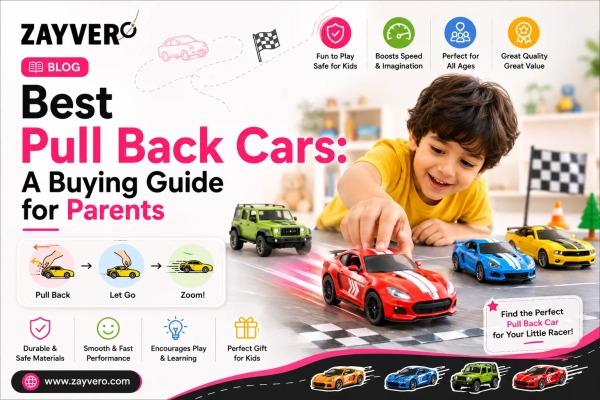
A pull back car uses a simple internal mechanism — usually a spring or flywheel — that stores energy when you roll the car backward, then releases that energy to propel the car forward once let go. No batteries, no remote, no charging required.
This simplicity is exactly what makes them appealing: a toddler can operate one just as easily as a school-age child, and there's no waiting around for batteries to charge or worrying about a lost remote. It's also part of why they're one of the most reliably durable toy categories — fewer components generally means fewer things that can break.
Why Pull Back Cars Remain a Favourite
Instant gratification. There's no setup, no pairing, no waiting. Pull it back, let go, and the car moves — which is a big part of why pull back cars tend to appeal even to very young children who don't yet have the patience for toys with more steps involved.
No batteries needed. Beyond the obvious cost savings, this also means no risk of a toy going flat mid-play, no battery compartment for small hands to pry open, and no environmental waste from disposable batteries.
Simple enough for solo play. Because there's no remote to coordinate or app to connect, pull back cars are one of the easiest toy categories for a child to enjoy entirely independently, without needing an adult to set anything up first.
Durable by design. Fewer moving parts and no delicate electronics generally mean pull back cars can survive drops, rough handling, and the general wear of daily play better than more complex, battery-powered alternatives.
What to Look For When Buying
1. The Quality of the Pull Back Mechanism
This is the single most important factor, and also the easiest to get wrong with cheaper products. A good pull back car should offer smooth resistance when pulled backward and a strong, consistent forward launch when released. Cheap mechanisms often feel gritty, inconsistent, or lose power noticeably after just a few uses — a sign of low-quality internal components that will likely fail within weeks.
2. Build Material
Die-cast metal pull back cars tend to be more durable and satisfying to handle than fully plastic ones, though they're generally pricier and heavier. Plastic cars are lighter, more affordable, and often safer for very young children, since they weigh less if thrown or dropped. Neither is universally "better" — it depends on your child's age and how roughly they tend to play.
3. Wheel Design
Good pull back cars use wheels with genuine, low-friction rolling ability — not just decorative wheels that spin poorly. Test this if possible by rolling the car forward manually before relying on the pull back mechanism; a car that rolls smoothly by hand will almost always perform better once the mechanism engages.
4. Size Relative to Age
Larger pull back cars are generally more appropriate for toddlers, since they're easier to grip and less of a choking risk. Smaller, more detailed die-cast versions suit older children who are more interested in realistic design and collecting multiple models.
5. Detail and Realism (For Older Kids)
Younger children are mostly drawn to colour, sound, and motion, while older kids — especially those with a growing interest in real vehicles — start caring about accurate design details, licensed vehicle models, and realistic proportions. Matching this to your child's actual level of interest avoids buying something that feels "too babyish" or, conversely, too subtle to hold their attention.
Choosing Pull Back Cars by Age
1–2 years: Choose large, chunky pull back cars with no small detachable parts. At this age, the appeal is almost entirely in the cause-and-effect — pulling it back and watching it shoot forward — rather than any design detail.
3–4 years: Slightly smaller cars with more colour and character variety work well here. This is often the age where kids start collecting multiples and racing them against each other or a sibling.
5+ years: Older kids can handle smaller, more detailed die-cast models, and often start showing preferences for specific vehicle types — sports cars, trucks, emergency vehicles — based on genuine interest rather than just colour or size.
Pull Back Cars vs. Remote Control Cars: What's the Real Difference?
It's a common question, especially since both fall under the broader "toy cars" category. The core difference comes down to control and complexity.
Pull back cars move in a single, uncontrolled forward direction once released — there's no steering, no remote, and no ongoing interaction beyond the initial pull. Remote control cars, by contrast, offer active, real-time control over direction and speed, which makes them more engaging for older kids but also introduces more cost, more parts that can fail, and a genuine learning curve for younger children.
Many families find pull back cars work best as an early, low-cost entry point into toy cars generally, with remote control cars introduced later once a child has the patience and coordination to handle active steering. If you're deciding between the two — or considering both — our guide on how to choose the best remote control car for kids breaks down what to look for on the RC side specifically.
Pull Back Cars and Track Sets: A Natural Pairing
Because pull back cars move forward on their own without needing a remote, they pair especially well with car track sets — the launch mechanism does a lot of the "racing" work automatically, which makes them a natural fit for loop tracks and ramps designed for hands-free motion. If your child already enjoys building layouts, our guide to best car track sets covers what to look for in a track that works well with this kind of car.
Common Mistakes When Buying Pull Back Cars
Judging quality by appearance alone. Two pull back cars can look nearly identical on the shelf while having completely different internal mechanism quality. Where possible, check reviews specifically mentioning how well the pull back function holds up over repeated use, not just how the car looks.
Buying oversized sets without checking individual quality. Multi-car value packs can be tempting, but they sometimes sacrifice individual build quality to hit a lower overall price point. A smaller pack of well-made cars often outperforms a larger pack of inconsistent ones in terms of actual play value.
Ignoring choking hazard risk for younger kids. Small die-cast cars, while popular with older children, are a genuine choking risk for toddlers and younger siblings in the same household. Always check the size and any small detachable parts against the youngest child who might have access to the toy.
Assuming all pull back mechanisms perform equally. Mechanism quality varies significantly between brands and price points. A slightly higher-priced car with a genuinely strong, consistent launch mechanism will almost always outlast and outperform a cheaper one that loses power within the first few weeks of regular use.
Caring for Pull Back Cars
Keep the wheels clean. Dust and debris caught in the wheel axles can noticeably reduce how far and how smoothly the car travels. A quick wipe-down or gentle blow of compressed air keeps performance consistent.
Avoid excessive force when pulling back. Pulling the mechanism back harder than intended doesn't make the car go faster — it just increases wear on the internal spring or flywheel mechanism over time, shortening the toy's usable lifespan.
Store away from extreme heat. Prolonged exposure to direct sun or a hot car interior can warp plastic components and affect the internal mechanism, particularly on cheaper, thinner plastic builds.
Check the mechanism periodically. If you notice the launch getting weaker or less consistent over time, it's often a sign of internal wear rather than something fixable — at that point, it's usually more practical to replace the car than attempt a repair.
Pull Back Cars as an Introduction to Collecting
For many kids, pull back cars become the entry point into a broader interest in collecting toy vehicles — and there are a few things worth knowing if that's the direction your child is heading.
Start with variety, not volume. A small collection of 4–5 genuinely different models (different vehicle types, colours, or themes) tends to sustain interest longer than a large set of near-identical cars, since variety gives a child more to compare, sort, and organise.
Introduce a display or storage system early. A simple shelf, a clear storage bin, or a dedicated basket gives a growing collection somewhere to live, and also turns tidying up into a small sorting activity in itself rather than a chore.
Let themes guide future purchases. Once you notice a pattern — emergency vehicles, sports cars, construction trucks — following that interest for future additions tends to keep the collection meaningful rather than random, and often extends naturally into other toy categories like track sets or RC cars later on.
Rotate which cars are "active." Just like with other toy categories, keeping the full collection out at all times can dilute interest. Rotating a smaller, active subset keeps individual cars feeling fresh rather than blending into a large, overwhelming pile.
Pull Back Cars as Gifts
Because they're affordable, durable, and require no batteries or setup, pull back cars make dependable gifts for birthdays, festive occasions, or small "just because" surprises — they suit a wide age range and rarely miss with kids who already have any interest in vehicles.
A few gifting tips worth considering: check whether the recipient already collects a specific vehicle type or brand, since a matching addition is often more exciting than an unrelated model. For younger recipients, prioritise size and safety over detail. For older kids, realistic design and licensed models tend to land better than more generic, simplified versions.
Frequently Asked Questions
What age are pull back cars appropriate for? Pull back cars are appropriate from around age 1, provided larger, chunkier models without small detachable parts are chosen for toddlers. Smaller, more detailed die-cast versions are better suited to children age 5 and up.
Do pull back cars need batteries? No. Pull back cars use a mechanical spring or flywheel mechanism that stores energy from the backward pull, requiring no batteries or charging at all.
Are metal or plastic pull back cars better? It depends on the child's age and play style. Die-cast metal cars are generally more durable and satisfying to handle but heavier and pricier, while plastic cars are lighter, more affordable, and often safer for very young children.
How long do pull back cars typically last? With reasonable care, a well-made pull back car can last for years, since the mechanism has relatively few components. Cheaper cars with lower-quality mechanisms often show noticeable wear within weeks of regular use.
Can pull back cars be used on car track sets? Yes — their self-propelled motion actually makes them a strong match for track sets, particularly loop and ramp-based designs, since no remote coordination is needed to keep them moving through the track.
Final Thoughts
Pull back cars remain a favourite for a simple reason: they deliver instant, satisfying motion without batteries, remotes, or setup, making them accessible to almost any age. Choosing one with a genuinely strong, well-built mechanism — rather than one that just looks good on the shelf — is what separates a toy that lasts for years from one that's disappointing within weeks.
Browse Zayvero's full Toy Cars collection, or visit Pull Back Cars to find options filtered by age and build type. Shop Now →